
A process model of emotion regulation was developed by Gross and John and described in a 2003 article in the Journal of Personality and Social Psychology.
According to this model, emotion may be regulated at five stages in the emotion generative process:
- selection of situations,
- modification of situations,
- focus of attention,
- change in cognition
- changes in experiential, behavioural, or physiological responses.
The first four of the regulation strategies focus on antecedents, whereas the fifth focuses on responses.
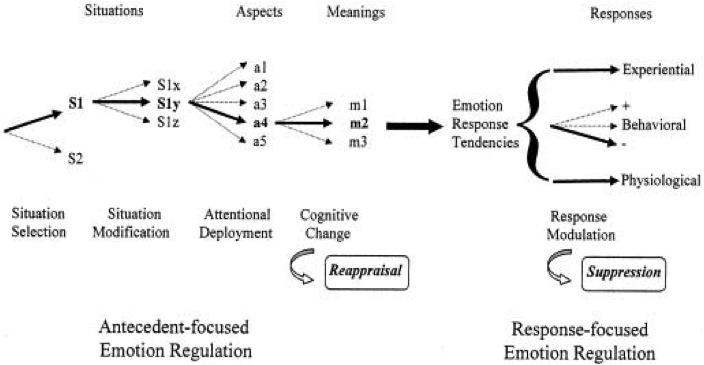
- Schutte, Manes & Malouff (2009) ‘Antecedent-Focused Emotion Regulation, Response Modulation and Well-Being’
- As predicted by the Gross and John process model of emotional regulation, antecedent focused regulation strategies were associated with greater well-being. Response-modulation strategies predicted no additional well-being beyond antecedent-regulation strategies.
- Individuals higher in emotional intelligence showed more antecedent-focused regulation
How do you regulate emotions?
Regulation of Emotion Items from Schutte et al. (2009)
- Selection of situations
- I spend time in situations that help me to feel emotions I want to have.
- I spend time in situations that prevent me from feeling emotions I do not want to have.
- I seek out situations that help me feel positive emotions.
- I avoid situations that lead me to feel negative emotions.
- Modification of situations
- I change situations so that they help me to feel emotions I want to have.
- I change situations that lead me to feel emotions I do not want to have.
- I change situations so they lead me to feel positive emotions.
- I change situations so they do not lead me to feel negative emotions.
- Attention deployment
- I pay attention to the things around me that help me to feel emotions I want to have.
- I pay attention to the things around me that prevent me from feeling emotions I do not want to have.
- I concentrate on things that help me feel positive emotions.
- I concentrate on things that block negative emotions.
- Cognitive change
- I change the way I think about things to help me to feel emotions I want to have.
- I change the way I think about things to prevent me from feeling emotions I do not want to have.
- I change my perspective on events to create positive emotions.
- I change my perspective on events so that I do not develop negative emotions.
- Experiential modulation
- When I have an emotion that I want to last, I focus on the emotion.
- When I have an emotion I do not want to have, I try not to think about it.
- When I have a positive emotion, I concentrate on it.
- When I have a negative emotion, I ignore it.
- Behavioral modulation
- When I have an emotion that I want to last, I show behaviours (e.g., talk about events connected to the emotion) that will make the emotion last.
- When I have an emotion I do not want to have, I show behaviours (e.g., try to resolve a conflict that led to the emotion) that will lessen the emotion.
- When I have a positive emotion, I behave in ways that will make the emotion more intense.
- When I have a negative emotion, I behave in ways that will weaken the emotion.
- Physical modulation
- When I have an emotion I want to last, I focus on the body signals (e.g., excitement) associated with the emotion.
- When I have an emotion I do not want to have, I ignore the body signals (e.g., sweaty palms) associated with the emotion.
- When I have a positive emotion, I focus on internal signs (e.g., a rush of energy) of the emotion.
- When I have a negative emotion, I block out internal signs (e.g., tense muscles) of the emotion.