
Social Cognitive Learning Theory View of Motivation
Social Cognitive Learning Theory is one of the best-articulated and researched theories that explains motivation and builds on theory and research focusing on cognitive processes and learning.
Observational learning
The basic premise of observational learning is that our potential for behaviour may change as the result of observing others’ behaviour. Thus, we can learn vicariously, that is, we do not have to ourselves show behaviour and experience its consequences in order to learn.
Several factors seem to determine whether we are motivated to show a behaviour similar to the one shown by another person, who is called a model in Social Learning Theory.
- The models we learn from may be live and they may also be symbolic, such as characters in books and films. Finally, we may learn from abstract or semantic information. For example, when reading an instruction manual or textbook, we learn from the abstract information presented. For humans all three of these types of models or sources of information have a tremendous impact
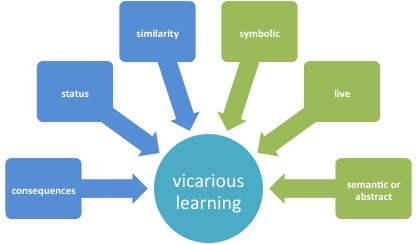
| CONSEQUENCESThe consequences of the model’s behaviour for the model influence whether we will show the behaviour ourselves. We may learn vicariously from rewards and punishments given to others. | STATUSThe perceived status of a model may influence the likelihood of our showing the behaviour modelled. We are more likely to be influenced by the behaviour of a high status or respected individual. | SIMILARITYThe perceived similarity of the model moderates the model’s influence. More similar people tend to have more influence. |
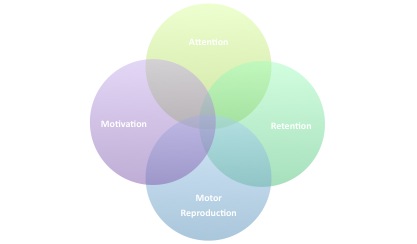
From: Braaksma, Rijlaarsdam, & van den Bergh (2002) article about model-observer similarity in Journal of Educational Psychology
- Ninth grade students who had low, medium or high argumentative writing skills
- practiced writing or observed models
- who were good writers,
- who were weak writers.
- Students who had low aptitude for the writing task performed best after watching models who were weak writers think aloud and perform.
- Students who had high aptitude for the task performed best after practicing writing themselves and next best after watching good writers think aloud and perform.
 Results of Braaksma et al (2002) observer-model similarity study.
Reciprocal Determinism
Social Learning Theory stresses the importance of interaction between the person and the environment.;
- Reciprocal determinism or reciprocal causation is the principle that a person’s specific behaviour, internal aspects of the person, and the environment all interact with each other, such that each one of the three can influence the other two.
- The environment may have an impact on her behaviour of helping the customer in the form of the customer complimenting her, which might influence the likelihood of the behaviour occurring in the future as well as altering internal person factors such as expectation of reinforcement.
Basic cognitive processes involved in learning from models
Several basic cognitive processes are required for an individual to learn from models.
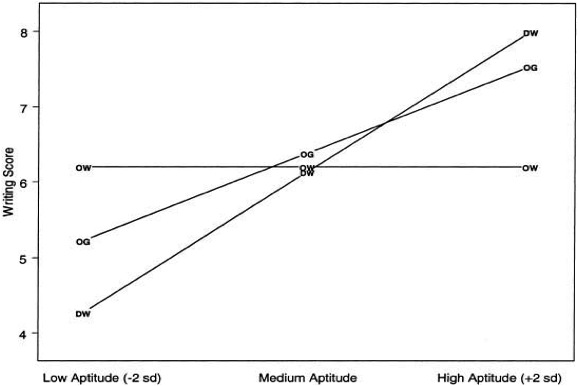
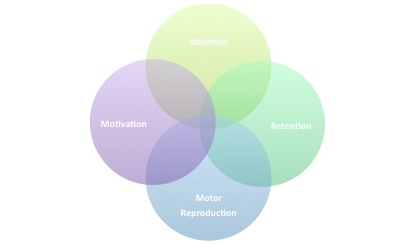
| Attention– noticing the relevant aspects of a model’s behaviour.
– tendency to be inundated with information in the environment that little notice is given to other people’s behaviour. |
Retention– after attending to a model’s behaviour one must retain or remember the behaviour in order for learning to occur.
– sometimes a model’s behaviour is so complex or provides information so different from other information in our cognitive system that it is difficult to retain. |
Motor reproduction– a person must have the motor reproduction skills to actually be able to show the behaviour that has been attended to and has been retained. | Motivation– to actually show a behaviour that has been attended to, retained, and for which one has the necessary motor skills, one must have the motivation (desire to show a behaviour). |
Vicarious Punishment
- Malouff, Thorsteinsson, Schutte, & Rooke, 2010 recently conducted a meta analysis of studies that examined the effect of vicarious punishment (observing another person experience a bad outcome).
Vicarious punishment is an interesting phenomena because the observer may learn a behaviour (and thus perhaps be more likely to later show the behaviour) by observing a model; on the other hand, observing the undesirable consequence experienced by the model may motivate the observer to not show the behaviour. Across 21 research samples and a total of 876 participants, the viewing of a model experiencing a negative consequence for a behavior led to a significantly lower level of the behavior by the observers. The motivational aspects of observing another person experience a negative consequence seem most important.